DAY 1 Ticket
Expires
in:
00
DAYS
00
HOURS
00
MINS
00
SECS
ADD THE SCHEDULE TO YOUR CALENDAR
WANT TO KNOW WHEN YOUR MUST-SEE PRESENTATIONS WILL GO LIVE?
Head to the community forum to RSVP for events and see the full skej!
SEE THE SCHEDULE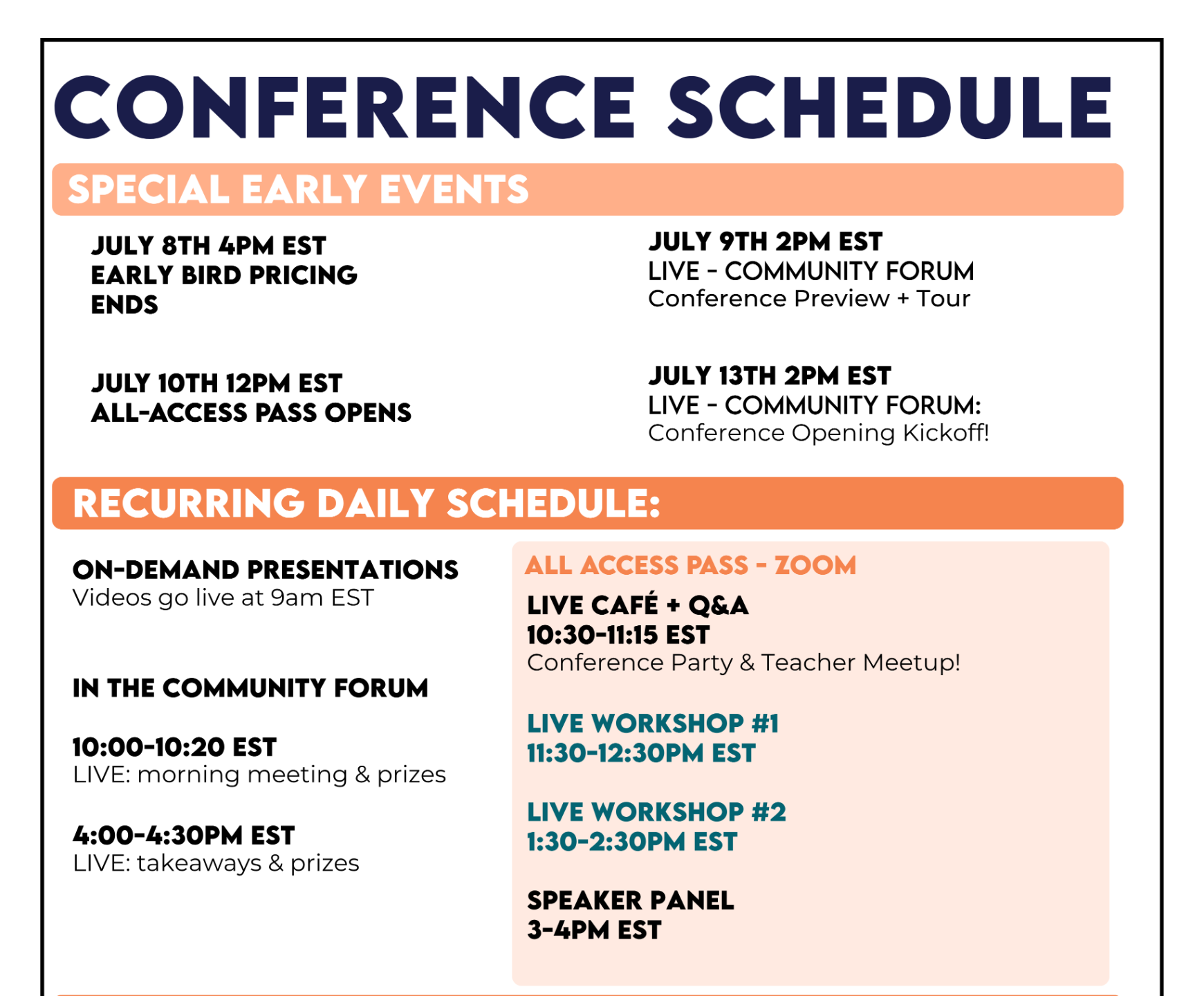
DAY 1- July 14th
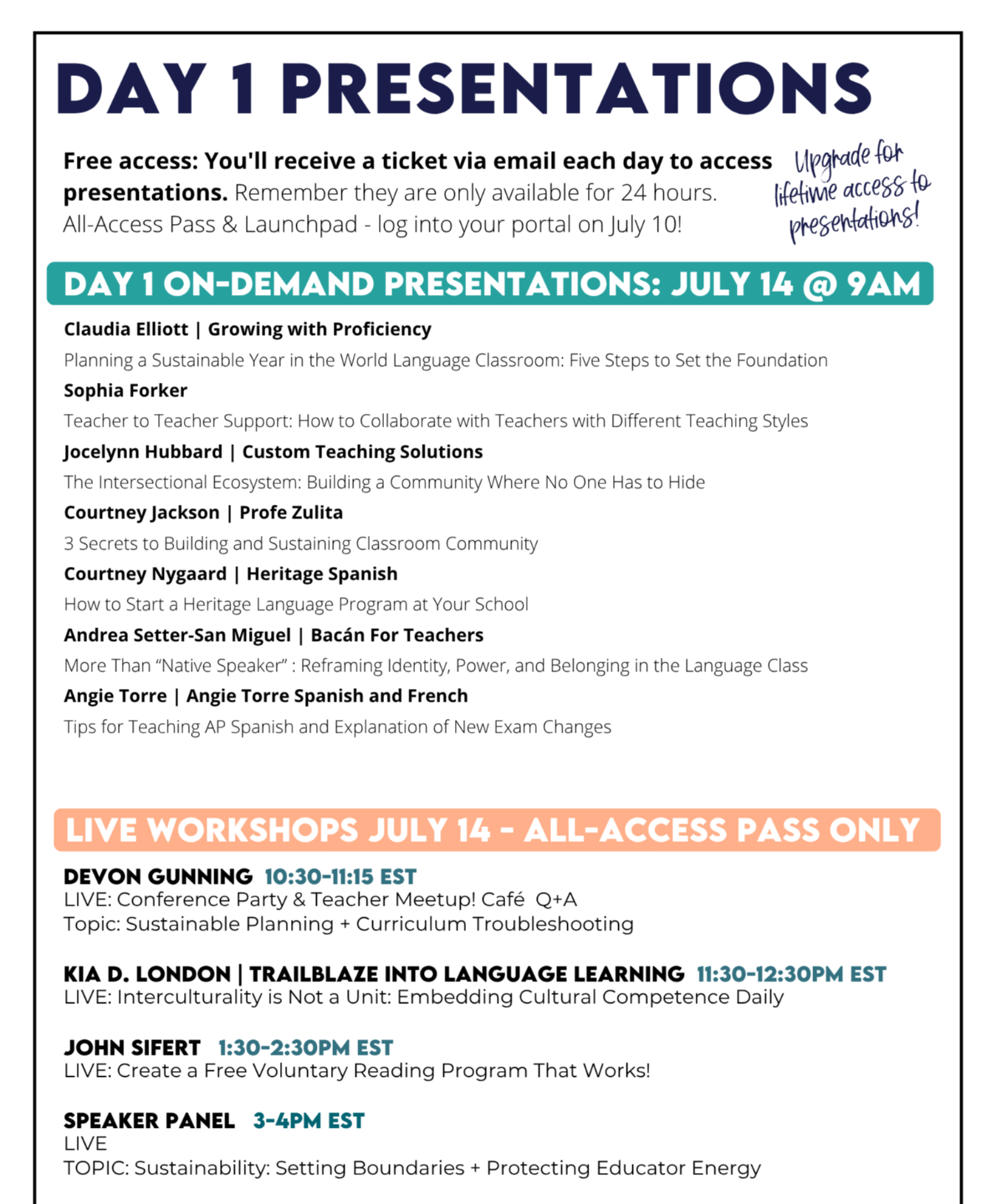
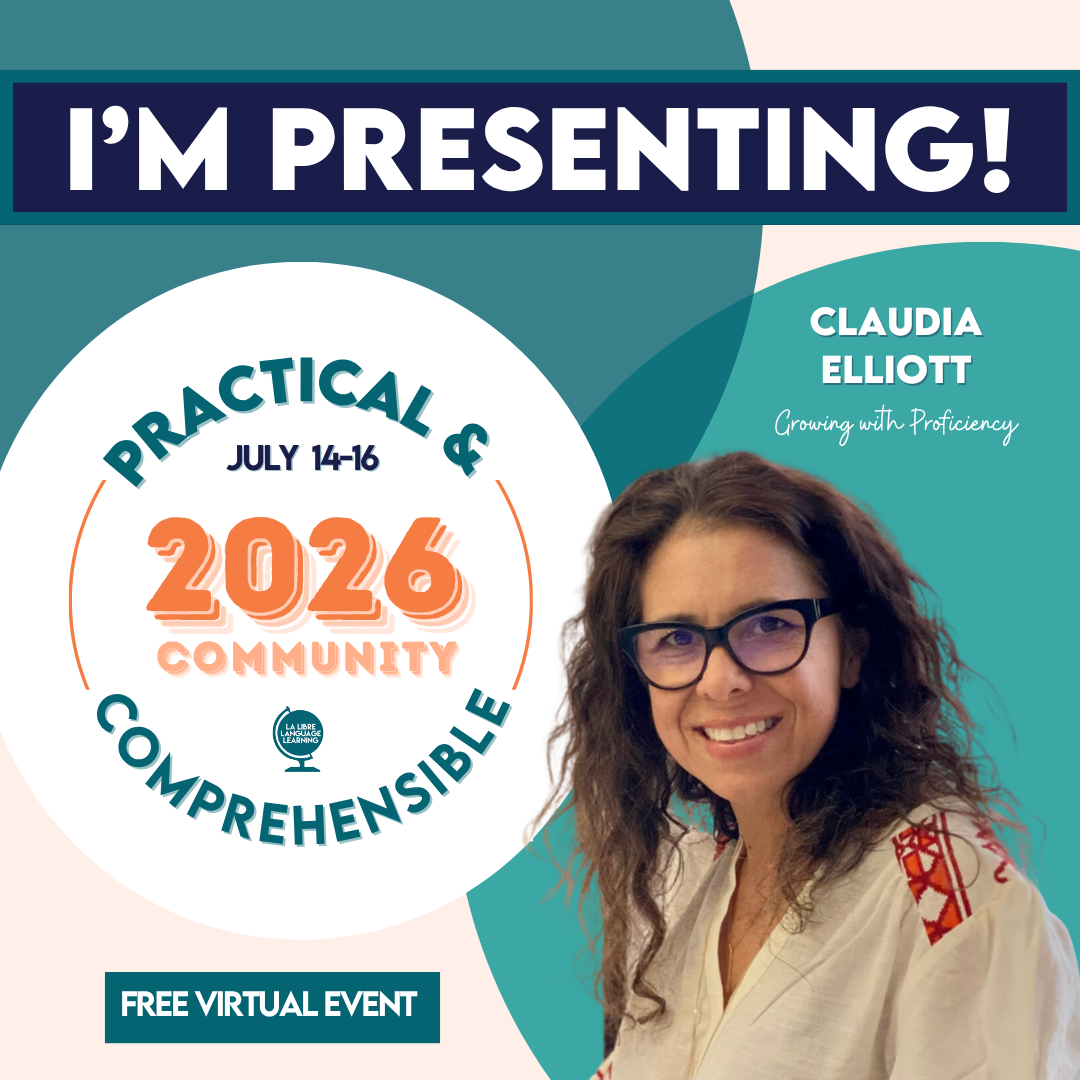
Claudia Elliott | Growing with Proficiency
PRESENTATION:
Planning a Sustainable Year in the World Language Classroom: Five Steps to Set the Foundation
Session Description:
Planning the school year can feel overwhelming—but it doesn’t have to be. In this session, teachers will learn how to design a sustainable, acquisition-driven year that supports both student growth and teacher well-being. Grounded in key principles of second language acquisition, we’ll explore why comprehensible input should guide our planning and how to center communication from the start.
Participants will walk through five practical steps: mapping the year with intention, identifying communicative anchors, reusing what works, filling gaps strategically, and simplifying to avoid burnout. You’ll see how to build units around meaningful communication using stories, songs, and other rich input while maintaining flexibility throughout the year.
Teachers will leave with a clear planning framework, actionable strategies, and a vision for a year that prioritizes connection, communication, and sustainability.
About Claudia:
Claudia Elliott is a Spanish teacher originally from Colombia, now living and teaching in the United States. With a teaching career that began in 2005, Claudia has taught all levels of Spanish, including AP and IB. Claudia has transformed her teaching practices from a traditional approach to one that is comprehensible, communicative, and community-driven.
Claudia has shared her ideas and experiences with world language educators at various forums and conferences. She was honored as the 2021-2022 FFLA (Florida Foreign Language Association) Teacher of the Year and the 2022 SCOLT (Southern Conference of Language Teaching) Teacher of the Year.
Claudia is also the host of "Growing With Proficiency The Podcast" and the founder of "Growing With Proficiency The Spanish Teacher Academy," where she helps world language teachers create engaging, comprehensible, and communicative-driven classes.
What does community to you?
Community means creating a safe place where everyone feels seen and heard. Community is what keeps us connected and willing to take risks and learn.
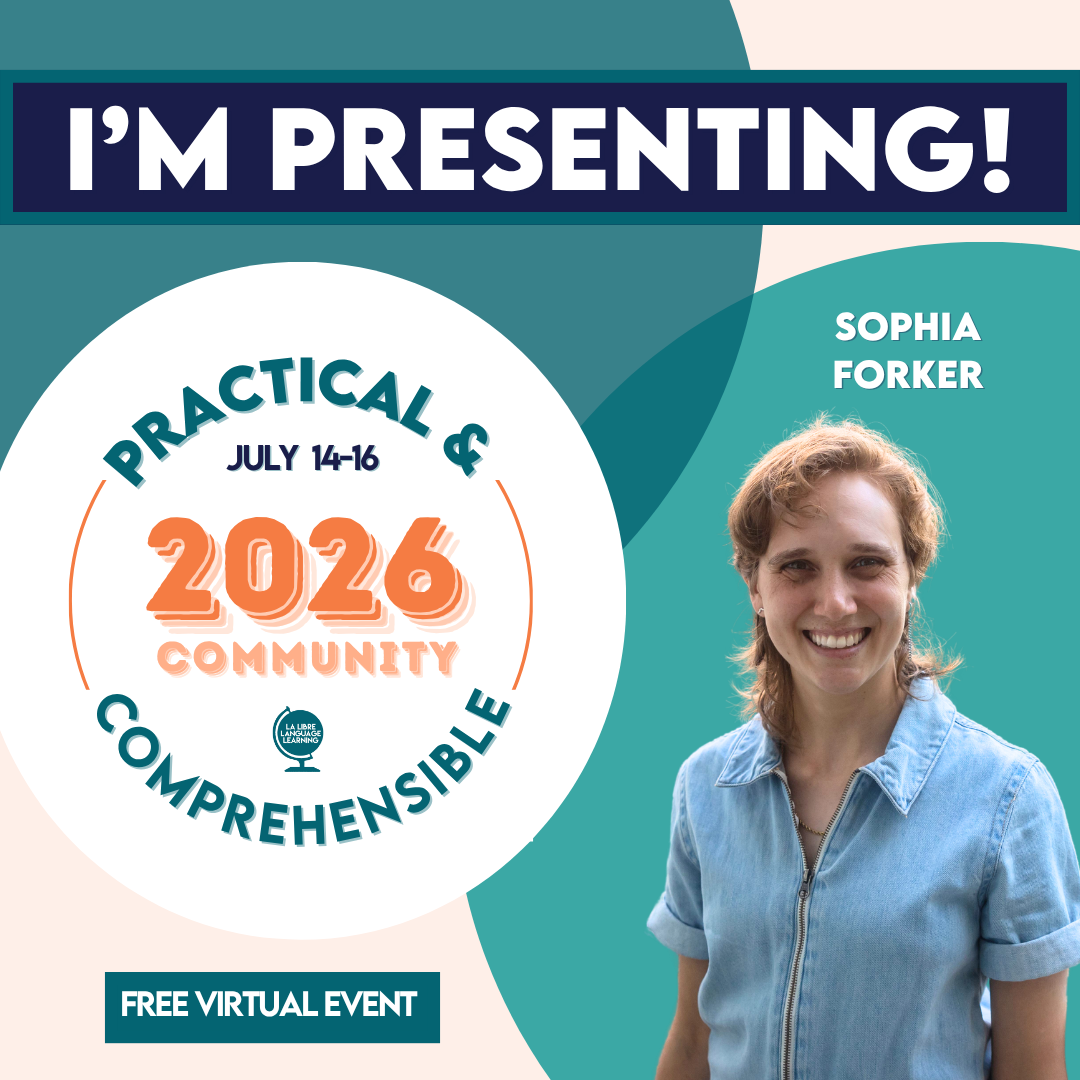
Sophie Forker
PRESENTATION:
Teacher to teacher support - how to collaborate with teachers with different teaching styles
Description:
In this interview, Sophie talks about how to work with colleagues with different styles, especially those who are not acquisition-driven. She discusses ways to find common ground, collaborate, and learn from colleagues with all language philosophies in mind.
About Sophie:
Bonjour ! ¡Hola! Hi! I'm Sophie, a French and Spanish teacher from Brooklyn, New York. I'm passionate about language acquisition, especially in tandem with queer affirming and antiracist pedagogy. I have taught both middle and high school in NYC public schools and have worked in traditional foreign language as well as dual language settings. I love learning about facilitating language acquisition in the classroom and I'm excited to share with all of you! In my free time I love spending time with my partner and our two dogs, Kevin and Snoodles.
What does community mean to you?
Community is showing up as my authentic self with students and building relationships with them. I love to see students making new friends in my class and how the group comes together during class, even if they aren't all best friends outside of class time.
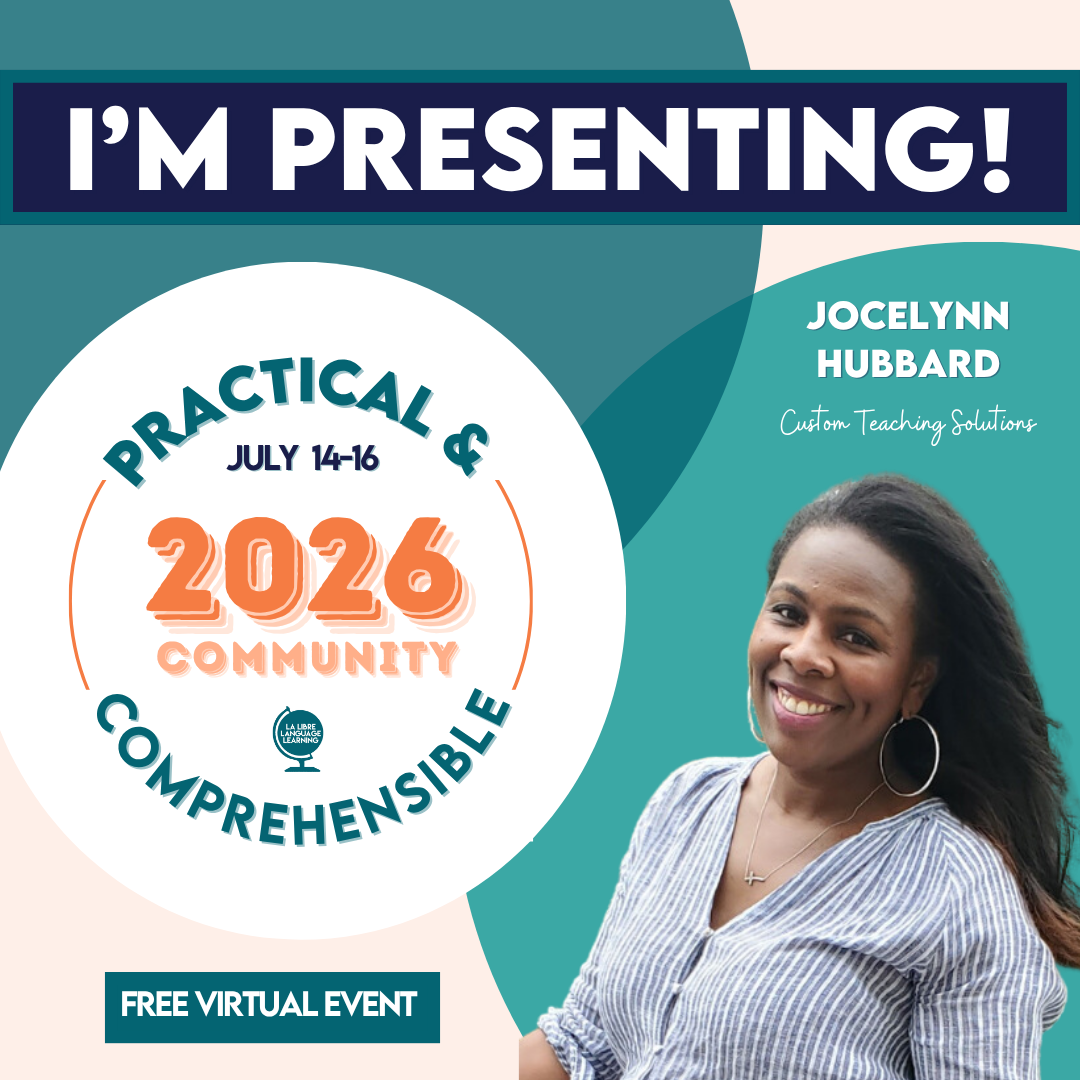
Jocelynn Hubbard | Custom Teaching Solutions (she/her)
PRESENTATION:
The Intersectional Ecosystem: Building a Community Where No One Has to Hide
Session Description:
A healthy classroom is a living ecosystem, yet teachers often carry the entire workload, leading to burnout. This session reframes classroom community by applying an intersectional lens to the students sitting right in front of us. By acknowledging the unique, overlapping identities of our learners—from the anxious high-achiever to the neurodivergent heritage speaker—we can build proficiency-oriented systems rooted in student agency rather than teacher-led compliance. We will explore sustainable systems that maintain relationships and protect teacher energy, allowing you to lead a community where every student (and teacher) can show up as their full self.
About Jocelynn:
Jocelynn Hubbard helps teachers spark joy during the learning experience by creating an inclusive and welcoming classroom environment for ALL their students. She is the founder and managing director of Custom Teaching Solutions, LLC and host of The Culture-Centered Classroom podcast. She has 16+ years of experience in education as an educator, speaker, professional development creator and facilitator. Driven by a passion to see the diverse people of our world feel welcomed, affirmed, and celebrated, she provides training on becoming and remaining culturally competent. As a wife and mother of five, her goals include squeezing in time for exercise, finding moments of joy each day, and parenting each of her children as unique individuals.
Jocelynn received a B.S. in Education from Miami University (OH) and an MA in Education from The University of North Carolina – Pembroke. She also has a graduate certificate in Gifted & Talented instruction from The University of North Carolina – Charlotte.
What does community to you?
For me, community this year means creating a classroom ecosystem where no one feels like they have to hide parts of themselves in order to belong; students or teachers. I want students to feel safe taking risks, making mistakes, participating authentically, and showing up fully as themselves.
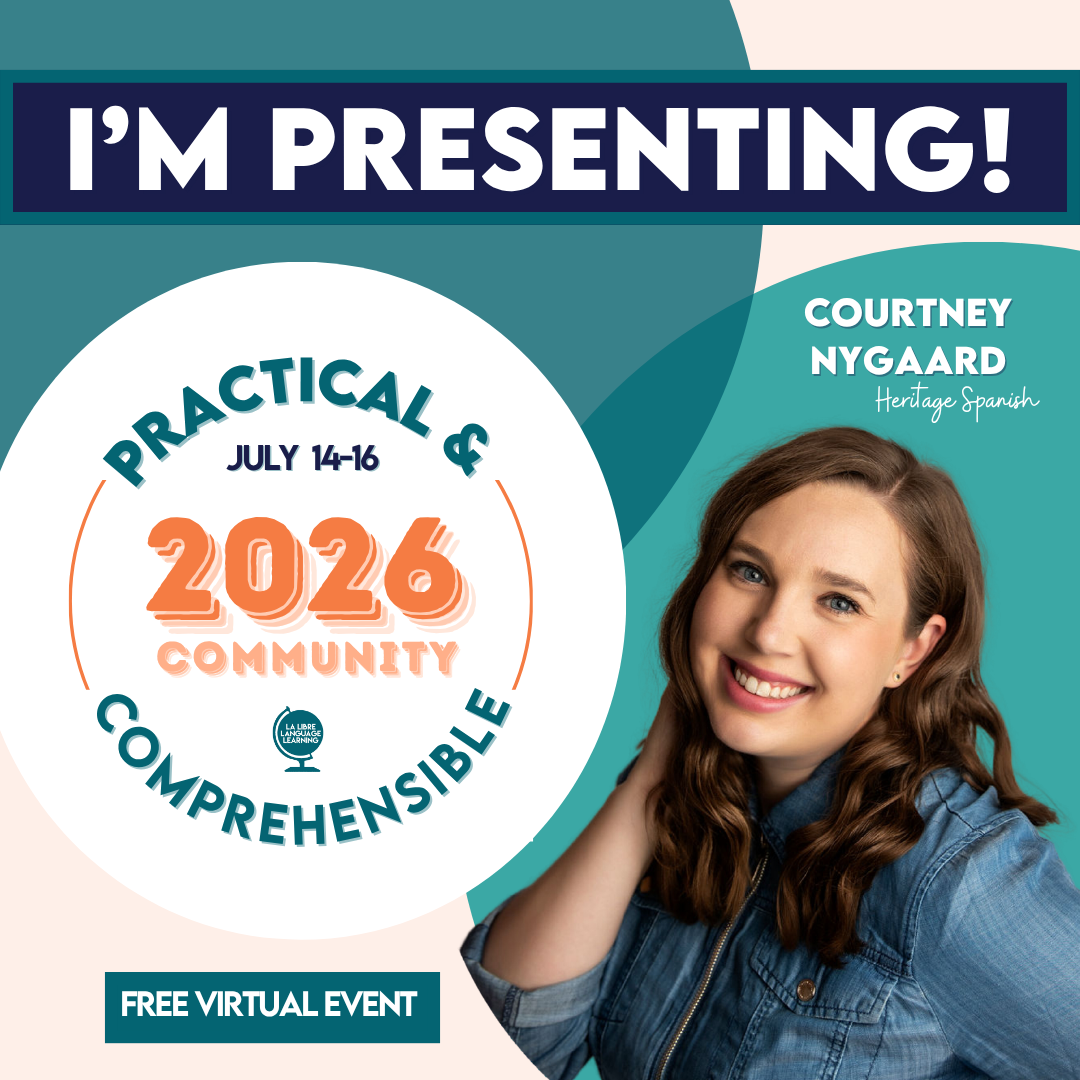
Courtney Nygaard | Heritage Spanish
PRESENTATION: How to Start a Heritage Language Program at your School
Session Description:
Learn in detail how to propose a heritage program for your school.
About Courtney:
Courtney is the founder of the Ascendencia curriculum for high school heritage Spanish and the Linaje curriculum for middle school heritage Spanish. Courtney’s primary focus is on engaging students in learning through content-based instruction. She believes in empowering her students to become their best selves and that the best learning takes place when students are hooked on a topic that directly relates to their life experiences.
What does community mean to you?
This year community in the classroom looks like working toward shared goals, inside jokes, and class celebrations.
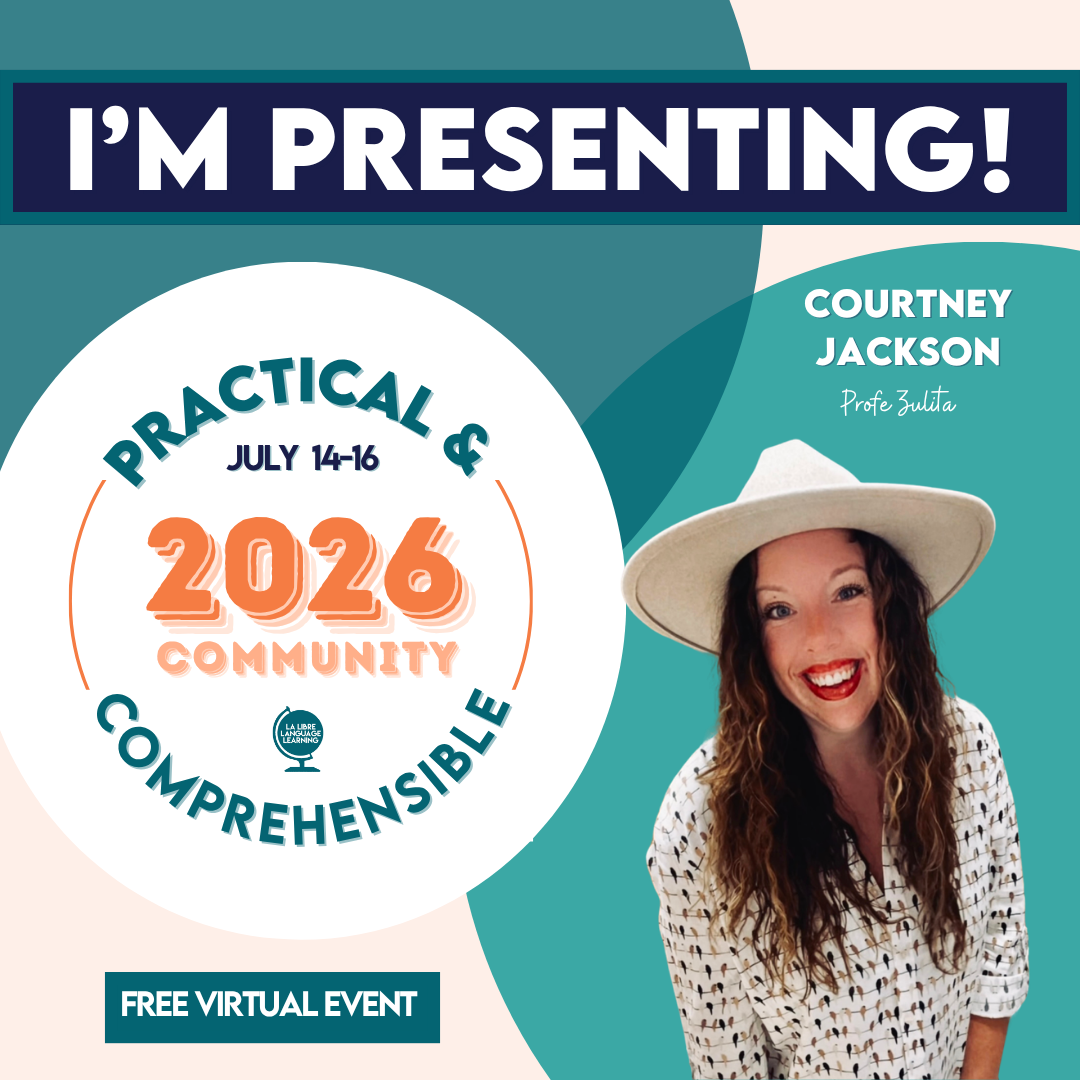
Courtney Jackson of Profe Zulita
Session:
3 secrets to building and sustaining community in the classroom
Session Description:
Courtney will walk you through step-by-step a very unique strategy where her school spends the first five days 100% on building community. There are 3 essential aspects of this building phase and some great activities that students often remember all year long. Join Courtney to see how spending that extra time on community makes all the difference for the year.
About Courtney:
Hi! My name is Courtney Jackson - aka, Profe Zulita. I'm currently a Middle School Exploratory, Spanish 1, 2, & 3 teacher in Denver, Colorado where I have the pleasure of serving Denver Public Schools as a World Language Regional Team Specialist - helping deliver professional development to teachers and support teachers throughout the school year. Outside of the classroom, I serve as a Colorado representative to Southwest Conference of Language Teachers (SWCOLT). Before joining my current role, I taught High School Spanish 1, 2, 3, & 4.
Outside of the classroom I enjoy taking kickboxing classes, exploring National Parks, and loving on my sweet chocolate lab, Loveland. I'm an avid travel that spend a lot of my time in Costa Rica with my partner and in Georgia seeing my niece and nephew.
What does community mean to you?
Community means everyone has a voice. Community means everyone is involved. Community means that everyone is working together.
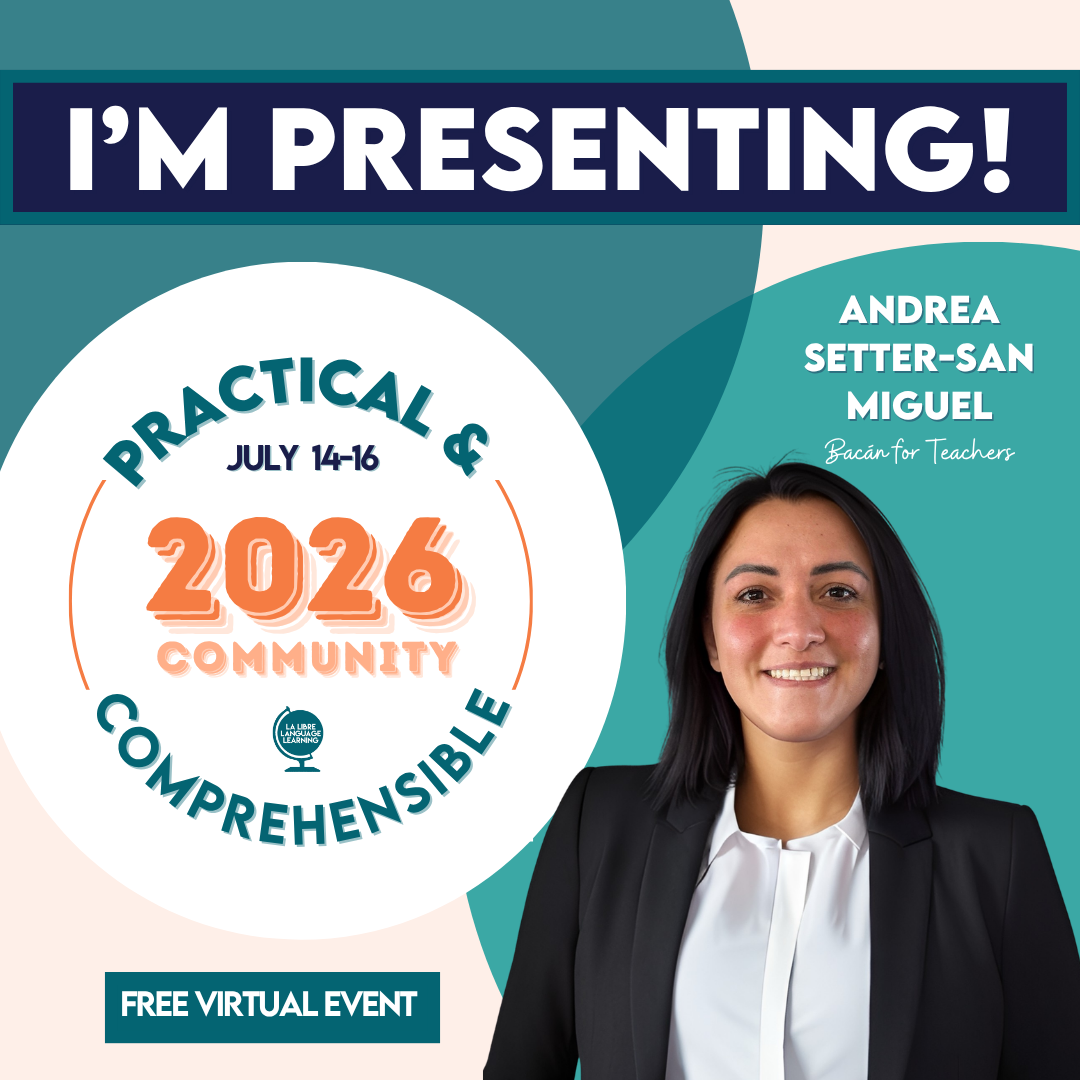
Andrea Setter-San Miguel, M.A. Ed. | Bacán for Teachers
Middle School Spanish Teacher
PRESENTATION:
More Than “Native Speaker”: Reframing Identity, Power, and Belonging in the Language Classroom
Session Description:
What messages - subtle or explicit - are we sending about who is “good” at language?
In many classrooms, certain identities are centered while others are quietly minimized. Heritage speakers feel unsure of their legitimacy. Multilingual students downplay their accents. “Native speaker” becomes the gold standard and everyone else feels slightly less than.
Community cannot thrive where hierarchy lives.
In this session, I will unpack how language classrooms can unintentionally reproduce linguistic power structures and how we can disrupt them.
As a multilingual educator navigating both Latin American and U.S. educational spaces, I’ll share how I intentionally:
-Redefine what proficiency and legitimacy look like
-Validate heritage speakers without isolating them
-Normalize diverse accents and linguistic journeys
-Shift classroom language away from deficit thinking
-Build a culture where multilingualism is power
Participants will leave with concrete language shifts, classroom protocols, and reflection tools that cultivate belonging while maintaining high expectations.
Because when students see their identity as an asset -not a liability - community becomes real.
About Andrea:
I’m Andrea, a native Spanish speaker and veteran language educator with over 15 years of experience in bringing confidence, connection, and joy into the Spanish classroom. I specialize in proficiency-based teaching that prioritizes authentic communication and student engagement — the kind of learning that sticks and lights up a room.
Through Bacán for Teachers, I support educators with ready-to-use, culturally responsive resources designed to make teaching more joyful and meaningful. My goal is to help teachers reconnect with their passion and create language classrooms full of laughter, growth, and genuine communication."
What does community mean to you?
To me, community this year means building an academic family where trust comes first. It’s about creating a safe space where students feel brave enough to take risks with Spanish, knowing that every mistake is supported by their peers as we build a bridge toward new cultures together.
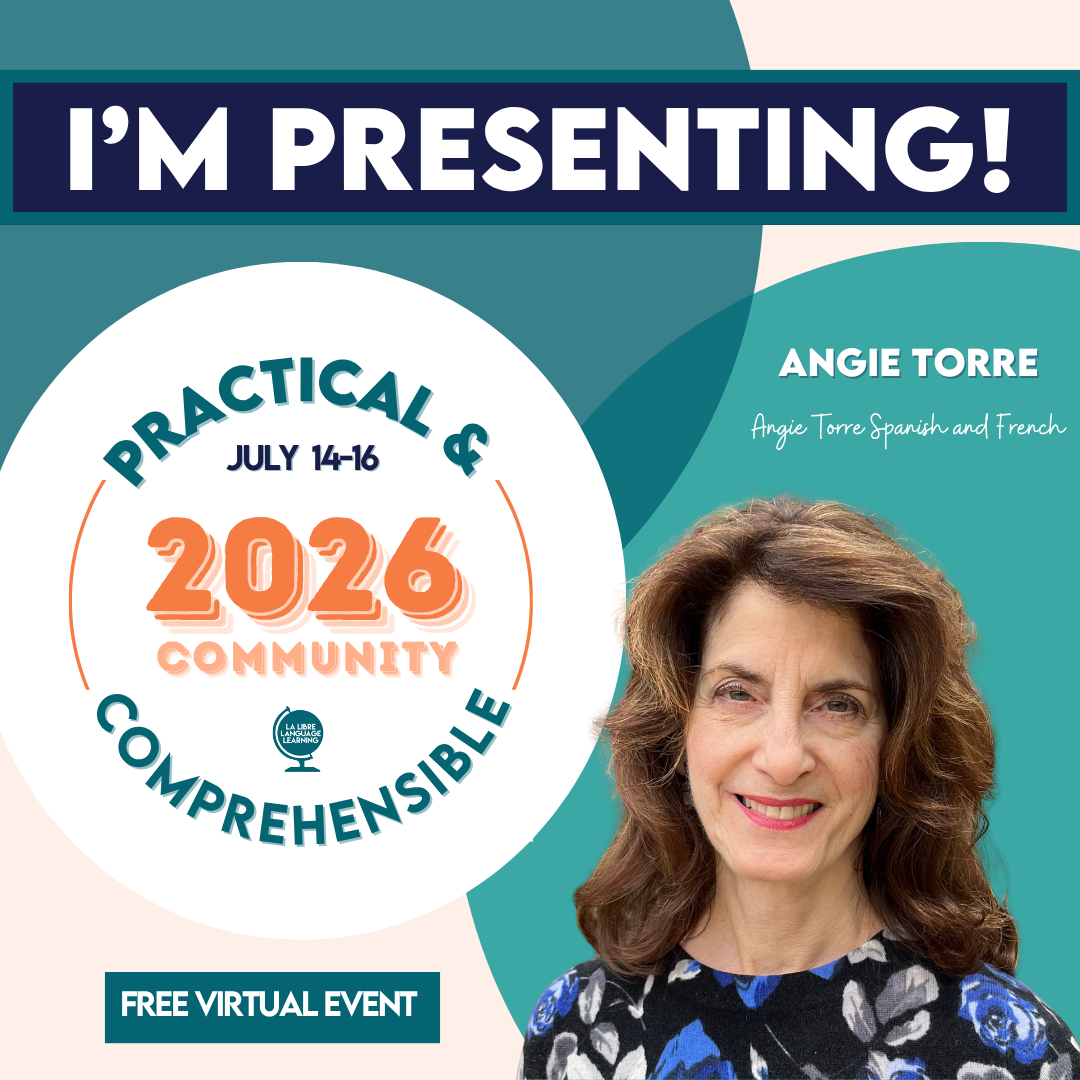
Angie Torre | Angie Torre French and Spanish
PRESENTATION: Tips for Teaching AP Spanish and Explanation of New Exam Changes
Session Description:
In this session, I will share some strategies for teaching AP Spanish Language and Culture that helped my students pass the AP exam. During the five years I taught it, all but one of my students passed the test. I’ll cover the following: how to help students master the listening section and the argumentative essay, two areas that students struggle with the most, and how to teach native and. Heritage speakers. I’ll also explain the changes to the exam and how to teach those new tasks, or at least what I’ve learned so far.
About Angie:
"With over 30 years of experience teaching Spanish (Levels I–AP) and French (Levels I–IV), I’ve dedicated my career to helping students not only become fluent but also articulate in the target language. During my 5 years teaching AP Spanish Language and Culture, all but one of my students passed the exam—an achievement I’m incredibly proud of.
My passion for sharing knowledge extends to my blog, where I connect with over 10,000 monthly readers. I offer practical teaching tips, innovative solutions to classroom challenges, comprehensible input strategies, TPRS tutorials, and tech integration ideas.
At the heart of my teaching philosophy lies the balance between comprehensible input and explicit grammar instruction. I believe students acquire language through exposure to meaningful content but also need structured grammar lessons to communicate clearly and effectively. My resources—ranging from textbooks and lesson plans to PowerPoints & digital activities—blend these approaches seamlessly, ensuring both engagement and academic rigor."
What does community mean to you?
Teaching is an interactive process in which both students and teachers learn from one another. By regularly placing students in pairs, groups, and teams, I help foster a sense of belonging in the classroom. When students feel connected, they enjoy learning more and acquire language more quickly.
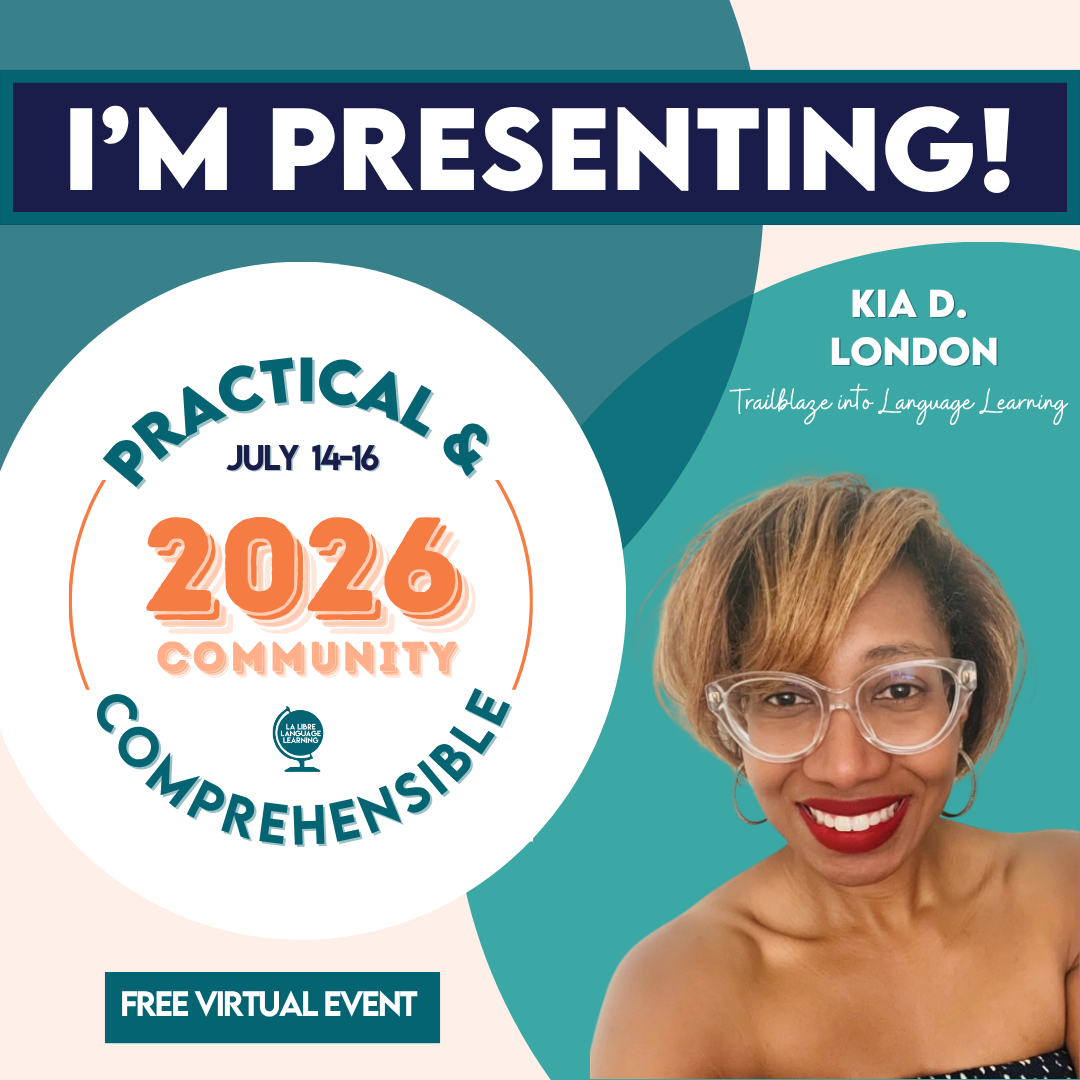
Premium Presentation - All-Access Pass only
LIVE SESSION
JULY 14 11:30-12:30 pm EST
Kia D. London | Trailblaze Into Language Learning (she/hers)
PRESENTATION: Interculturality is Not A Unit: Embedding Cultural Competence Daily
Session Description:
Leading with culture is an essential component of acquiring a language that should be woven into daily instruction. In this workshop, participants will explore how to intentionally embed intercultural competence into everyday classroom practices, helping students develop the skills to investigate, interpret, reflect, connect, compare, and engage with diverse perspectives. Through authentic examples, instructional strategies, and reflective activities, educators will learn how to move beyond cultural "add-ons" and create meaningful opportunities for students to make connections between language, culture, and identity. Participants will leave with practical tools and resources to foster interculturality as an ongoing habit of learning rather than a standalone portion.
About Kia:
Kia is a passionate educator, writer, and advocate for equity by way of reading, representation, and interculturality in the world language curriculum. She earned a B.A. in Spanish and an M.A. in Linguistics, specializing in language and identity. She carries eighteen years of experience in the classroom, and has taught Spanish to multilingual learners for all grade levels K-12. She currently teaches Spanish to 5th and 6th grade students.
Through Trailblaze Into Language Learning, Kia provides workshops, webinars, and a curriculum coaching membership program focused on student representation, second language acquisition, belonging, and intercultural competence. She has presented at local, state, and regional conferences, as well as the ACTFL conference. As a writer of comprehensible short stories and articles, she successfully designs a rich curriculum that keeps her students engaged!
What does community mean to you?
This year in the classroom, COMMUNITY means belonging, empathy, and shared experiences.
Get Access to Live Workshops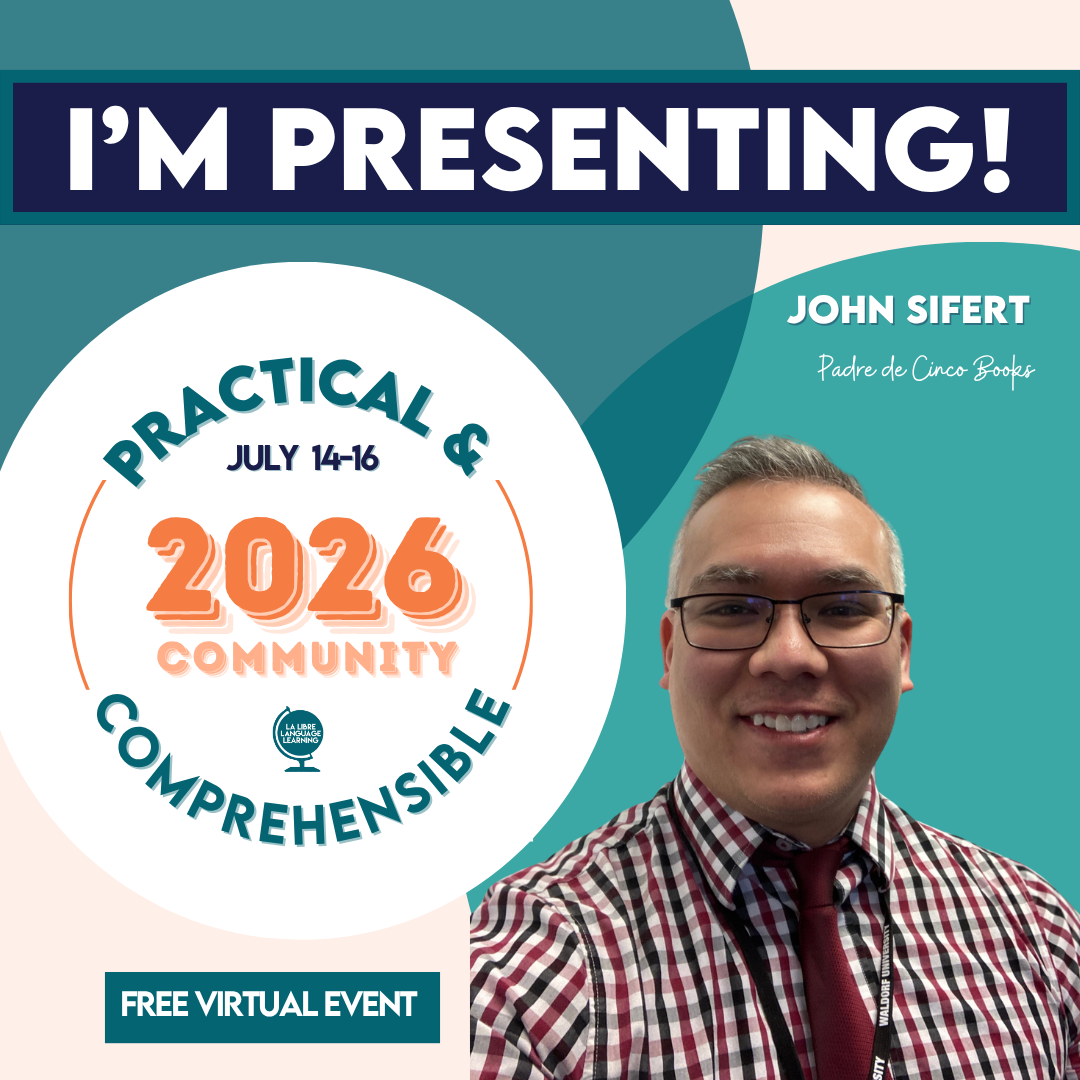
Premium Presentation - All-Access Pass only
LIVE SESSION
John Sifert, Padre de cinco Resources
JULY 14 1:30-2:30pm EST
Create a Free Voluntary Reading Program that Works!
About John:
"John Sifert has been a Spanish teacher in Iowa for the past 28 years. His focus in the classroom is to provide comprehensible input through stories, novels, and song. He is also passionate about teaching students about life-long skills such as perseverance, respect, and kindness. John has presented at ACTFL, CI Midwest, Practical and Comprehensible, IWLA, CI Iowa, KSWLA, Comprehended!, Conference in the Cloud, Growing with Proficiency, and CI Reboot. John also creates a variety of classroom materials and is the author of La isla más peligrosa, La decisión más peligrosa, El secreto más peligroso, Seis nombres, L'isola più pericolosa del mondo, with several other novels in the works. You can find all his ideas and materials at padredecinco.com
Nothing is more important than family, so when not focused on language acquisition, John spends all his free time with his wife and 5 children in the tiny, (but amazing) town of Belmond, Iowa.
What does community mean to you?
Community is putting unity before units, empathy before exams, and connections before curriculum.